- Author: Vijay Raj P
- Working As: Assistant Manager [Administration & Outsourcing]
- Published On: 13 February 2026
- Share your thought at: [email protected]
Impact in Action: Strengthening WASH Practices in a Government Rural School in Telangana
Access to safe water, sanitation, and hygiene is fundamental to a child’s health, dignity, and right to learn. Guided by this belief, REEDS (Rural Economic and Educational Development Society) – established in 1989—conducted a WASH (Water, Sanitation & Hygiene) program at a Government rural schools of Narsapur, Bandamailaram, Kokkonda & Kothur [MPPS] in Telangana. This initiative reflects REEDS’ long-standing mission to promote health, education, and sustainable development in rural communities.
Engagement with the school community revealed that while basic infrastructure was in place, there was a strong need to strengthen hygiene awareness and reinforce daily healthy practices among students. REEDS identified that simple, low-cost interventions—such as visual hygiene reminders and structured routines—could significantly improve student well-being and school hygiene standards.
It was truly heartening and joyful to interact with rural children and conduct learning sessions with them, as their curiosity, enthusiasm, and willingness to participate made the experience meaningful for everyone involved. REEDS facilitated interactive handwashing sessions, training students on the 7-step, 20-second handwashing technique. The “pepper and soap” experiment became a powerful learning tool, helping children clearly understand how germs spread and how proper handwashing prevents illness.
Complementing this, students participated in engaging discussions on personal hygiene habits, including brushing teeth, regular bathing, wearing clean clothes, and trimming nails—reinforcing the importance of everyday practices for lifelong health.
Aligned with its holistic development approach, REEDS conducted a comprehensive assessment of WASH and school infrastructure. This included drinking water facilities, sanitation, hygiene awareness, classrooms, learning resources, sports facilities, and kitchen arrangements. The assessment highlighted key gaps such as the absence of visible IEC materials, limited sports equipment, lack of a stand-alone kitchen, and missing science and computer laboratories—areas critical for a safe and supportive learning environment.
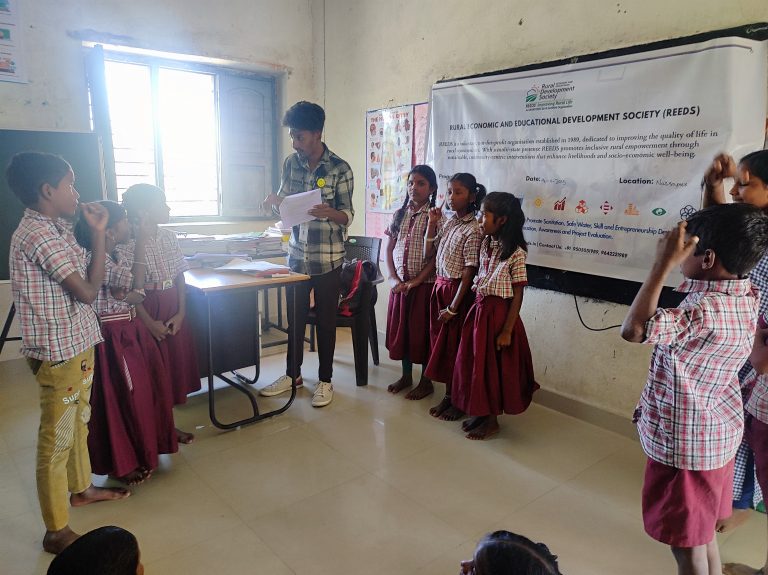
REEDS worked closely with school leadership and teachers to identify priorities and integrate hygiene practices into daily school routines. Emphasis was placed on shared responsibility, regular monitoring, and sustainability to ensure that positive changes continue beyond the program period.
This WASH initiative is expected to lead to improved hygiene behaviour, reduced illness and absenteeism, and a safer, healthier learning environment. By empowering children with knowledge and practical skills, the program also enables them to become health ambassadors, spreading awareness within their families and communities.
Through initiatives like this, REEDS continues to advance its vision of empowered, healthy, and educated rural communities. Strengthening WASH practices in schools not only safeguards children’s health today but also lays the foundation for confident learners and resilient communities tomorrow.